03 March 2026
Optimizing Offshore maintenance for a more reliable energy future
The project is a joint initiative that brings shared data and artificial intelligence together to coordinate offshore wind maintenance across multiple transmission system operators, reducing costs, emissions, and downtime while improving the reliability of the energy system.
Context / Why this project
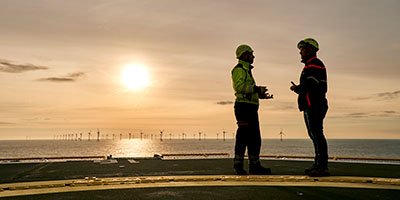
Offshore wind energy plays an important role in Germany’s and the EU’s energy transition. As more offshore wind farms feed power into the electricity grid, the reliability of offshore infrastructure becomes even more critical. Offshore platforms and submarine cables act as critical hubs: they collect electricity at sea and transport it safely to land, ensuring security of supply for million of customers.
However, maintaining these offshore assets is a complex and costly task. Challenging weather, limited access windows, high operational costs, and separate planning processes across different transmission system operators (TSOs) make maintenance difficult and inefficient. Today, each TSO manages its own maintenance cycles independently, often leading to duplicated efforts, higher costs, and avoidable downtime.
A shared challenge requires a shared solution
- Offshore maintenance is costly and offshore logistics are difficult.
- Planning across multiple TSOs is not coordinated, even when assets share similar constraints.
- Data is stored in silos, making it hard to use advanced analytics or AI.
- There is no shared platform to support joint planning of ships, external teams, and time windows.
The result: unnecessary emissions, higher costs, and reduced availability of offshore energy infrastructure.
Offshore maintenance is still planned largely per TSO, despite shared constraints and overlapping operational environments. Data remains stored in silos, with asset information, maintenance histories, weather data, and logistics spread across separate systems. This fragmentation limits the use of advanced analytics and AI.
At the same time, there is no shared platform to coordinate maintenance activities across TSOs. Vessels, external teams, and access windows are planned independently, leading to duplicated effort, higher costs, unnecessary emissions, and avoidable downtime.
Offshore Wind Energy Maintenance Optimization (OWiMO) addresses this gap through a joint initiative between multiple German TSOs and their partners, including 50Hertz, Amprion, and TenneT Germany. The project aims to enable shared, AI‑supported maintenance planning while respecting operational constraints and fairness between partners.
From fragmented data to intelligent maintenance planning
OWiMO addresses offshore maintenance inefficiencies by bringing fragmented data together and making it usable across organizations. Technical asset data, maintenance records, condition and monitoring data, weather information, and logistics constraints are integrated into a harmonized, machine‑readable structure. This shared data foundation enables consistent analysis across assets and operators.
On this basis, OWiMO applies AI‑supported analytics and planning to anticipate maintenance needs and support coordinated decision‑making across TSOs. Predictive models help identify when maintenance is required, while joint planning mechanisms enable better alignment of vessels, external teams, and time windows under real operational constraints.
To ensure practical applicability, the approach is validated stepwise: first on real onshore reference assets, and later through shadow‑pilot operations, where AI‑generated maintenance plans run in parallel to existing processes. This allows results to be tested and refined before any offshore deployment.
The role of 50Hertz in the OWiMO project
50Hertz contributes:
- experience in offshore and onshore asset management
- integration of its asset management systems into the new platform
- development of fair multi TSO coordination mechanisms
- validation through reference assets and shadow pilot testing
Our goal is to enable data driven, collaborative maintenance that strengthens security of supply and accelerates the energy transition.
Partners
 |
 |
 |
 |
 |