24 August 2026
Boosting overhead line capacity with a high-emissivity coating
As electricity demand rises and renewable generation grows, Elia Group is exploring ways to unlock more capacity from existing overhead lines. AssetCool tests whether a high-emissivity coating can help conductors stay cooler, increasing transfer capacity without replacing the line
Context
The energy transition and electrification are driving a rapid increase in power flows, while permitting and building new lines remains slow and expensive. As a result, the grid faces growing congestion, and grid operators need to make better use of existing assets.
Heat is the hidden enemy of overhead lines. When a conductor heats up, under high load or strong sun, it sags and its transfer capacity has to be limited (a loss of roughly 10–15%). Reducing solar heating and improving heat dissipation could unlock additional capacity.
That is exactly what the high-emissivity coating is designed to do:
- Increases solar reflection (reduces heating from the sun / UV), and
- Increases thermal dissipation (helps the conductor shed heat).
This makes it a fast, low-cost lever to relieve congestion and support grid growth by increasing the capacity of existing lines rather than building new ones.
Approach
The exploration project structured around four work packages, moving step by step from the lab to a real field pilot:
- Laboratory validation: characterise the coating and run durability tests (salt-spray/corrosion, UV, sand erosion, water & humidity resistance, combined ageing cycles) to confirm that the coating meets technical and operational requirements.
- Operational testing under realistic conditions: test on a full-scale bench to see how maintenance operations (spacers, spirals, jointing, working platforms, etc.) affect the coating.
- Preparation for a field pilot: select a suitable line section with limited operational risk and span and define the work method for installing the coating robots on the line.
- Monitoring and evaluation on a real line: install on a real line, monitor performance and durability, and evaluate the results.
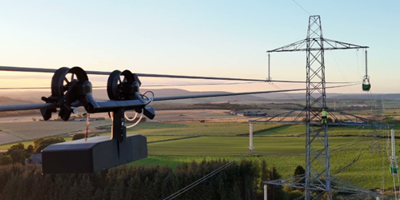
The coating is applied on the live line by robots: one robot cleans the conductor and a second applies the coating, avoiding the need to replace conductors. The project is run in collaboration with other Transmission System Operators to share information and costs on our different initiatives.
Results
The early findings are very promising:
- Theoretical capacity gain of roughly +11% to +15% depending on the conductor type (e.g. +14.6% on AMS445), based on Elia Group’s nominal-current calculations.
- Early business-case assessments indicate that the technology could be economically attractive in situations where additional capacity is needed before structural grid reinforcements can be completed.
- Lab characterisation and durability testing are in progress to confirm lifespan, ageing behaviour and operational impact.
Next steps
- Continue the ongoing durability lab tests on the supplied conductor sample.
- Run the maintenance-related tests on the representative test line this year, to check how the coating behaves during and after typical maintenance operations.
- Test the installation itself, including whether recent drone developments could support the installation process
- Subject to successful validation: run the field pilot at the end of 2027 or the beginning of 2028.
Partners
  |
 |
 |
 |
 |
 |
 |
 |