30 October 2026
Moonshot update: Enhance grid engineering: Advanced conductors for electricity transmission
What if Elia Group could transmit up to four times the power in the same footprint using new grid engineering solutions? This Moonshot assesses whether advanced underground conductors, such as Superconducting Cables and Gas Insulated Lines can be a cost-effective and reliable part of our toolbox to address future grid challenges.
Context
This project is one of five Moonshots in Elia Group’s new Moonshot programme, which brings together ambitious innovation projects designed to address key challenges for the future energy system and deliver significant impact. This Moonshot tackles one of the most pressing of these challenges: how to transmit up to four times more power within the same footprint, where space is scarce?
As the energy transition advances, the integration of renewables and electrification continuously require more transmission capacity, often in places where space is limited or where the surroundings impose specific constraints. In such situations, conventional overhead lines and underground cables can become costly, complex to implement or simply unsuitable due to their footprint.
Advanced conductors could be an answer in the future. Elia Group is looking into two specific technologies:
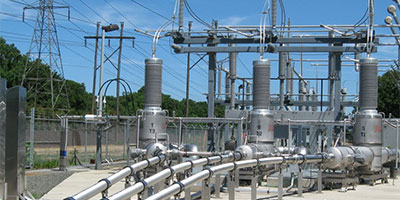
- Gas Insulated Lines (GIL)
Rigid conductors placed inside a grounded metal enclosure filled with an insulating gas. In the past, this insulating gas was typically SF6 or an alternative. In this project, Elia Group is looking at GILs with SF6-free gas mixtures. This makes GIL acceptable from a sustainability point of view, combining a very high current rating with low losses and a small footprint. - High-temperature Superconducting (HTS) Cables
Cables whose electrical resistance drops to zero when cooled below their critical temperature, typically using liquid nitrogen. This allows very high power to be transmitted with almost no losses in a very small footprint.
This project builds on our earlier assessment of superconductivity for electricity transmission and broadens the scope to advanced conductors in general, with several technologies now assessed side by side.
Potential benefits of advanced conductors
High power density
Both GIL and HTS can transmit significantly more power than a conventional cable of the same voltage, reducing the number of circuits needed.
Reduced space requirements
A smaller footprint means less land use and narrower corridors, which limits the required civil works and land use.
Reduced civil works
Thanks to their compact design and high power density, advanced conductors can require narrower trenches, fewer parallel circuits and less extensive civil works. For certain projects, this could positively impact the business case and help offset the higher cost of the technology itself.
Low external electromagnetic field
Thanks to their enclosure or superconducting shielding, these technologies have a very low external magnetic field, which can make them suitable for locations where magnetic fields need to be kept to a minimum such as close to other connections or in tunnels.
However, these benefits come with challenges: higher investment costs, additional supporting equipment (gas handling or cooling systems), specific safety requirements and very limited operational experience in high-voltage transmission grids. Understanding where these technologies are truly cost-effective is therefore key.
Approach
In order to fully understand the state-of-the-art and actual cost, Elia Group launched an assessment, consisting of a technology assessment, market consultation and affordability assessment.
Request for Information (RFI)
Elia Group has issued a Request for Information (RFI) to the market. GIL, HTS and other innovative underground high-power-density solutions are all welcome. The RFI is based on a number of theoretical use-cases where conventional solutions might be less cost-effective or unsuitable.
The RFI is non-binding. Its purpose is to learn what the market can deliver today.
Technology and affordability assessment
Based on the responses, we will assess the technology maturity, feasibility, indicative cost and lead time of each solution, and compare them with conventional alternatives. This will show where advanced conductors could offer a more affordable or more practical solution for the grid and whether or not these would be a valuable addition to our toolbox.
Next steps
Following this phase, Elia Group will determine whether a pilot or demonstrator is warranted.
How to get involved?
The RFI is running in Q4 2026 and the responses will be evaluated after the response deadline. We welcome input from manufacturers, technology developers and research partners on GIL, superconducting cables or other high power-density transmission solutions, including interest in co-development, pilots or demonstrators.
If you are interested in participating or have any questions on this topic, don’t hesitate to contact us!